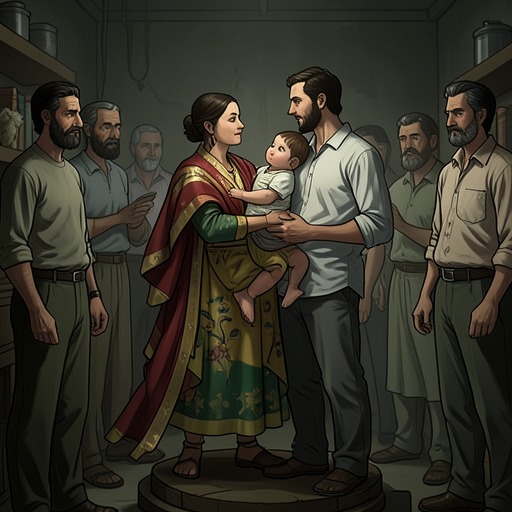
Biological Fatherhood and Nurturing Fatherhood
Black BoxBiological Fatherhood and Nurturing Fatherhood is a central tension in the novel’s account of Alexander Gideon and Boaz Brandstetter. Their biological connection remains legally unconfirmed, while the responsibilities and attachments usually associated with fatherhood are distributed among Alexander, Michel Sommo, and Boaz himself. The distinction is not settled by a test or a name: it emerges through decisions about custody, money, protection, and the daily labor of care.
Paternity, Law, and Custody
The uncertainty begins in the divorce proceedings between Alexander Gideon and Ilana Sommo. A blood test did not establish paternity unambiguously, and a tissue test was proposed but not carried out. The Rabbinical Court ruled on the marriage and its financial consequences; the Jerusalem District Court separately considered Ilana’s maintenance claim for herself and the child. Its record notes that both spouses declined tissue testing and that Ilana withdrew the claim, after which the court recorded that neither had further demands on the other. The legal separation thus closed claims without resolving the personal question of who Boaz’s father was.
Years later, Ilana explains that she had wanted maintenance and property but would not pursue them at the cost of losing Boaz. Her lawyer had warned that a test establishing Alexander’s paternity might enable the courts to grant him custody. She believed Alexander might take the child and leave her money instead. Her refusal was therefore not simply resistance to establishing biological truth: as she describes it, it was a decision to protect her relationship with Boaz, even at substantial economic cost. She later tells Alexander that she and Boaz had been left without adequate support, and that earlier assistance could have allowed her to raise him at home.
Alexander’s own account makes the conflict less straightforward than a contest between a caring mother and an indifferent biological father. In a private note, he admits that he could not bring himself to take Boaz and did not know how to care for him. He feared that agreeing to the test might result in a court order placing the boy with him, and wondered what Boaz’s life would have been in his care. His admission exposes the gap between biological status and the capacity to parent: legal recognition could have imposed a relationship that Alexander did not know how to live.
The Unperformed Gift and the Limits of Money
Ilana reveals another side of Alexander’s attachment when she recounts Boaz’s kidney infection at eight. Without her knowledge, Alexander consulted a doctor about whether an adult could donate a kidney to a child and said he would donate one of his own if necessary, on the condition that Ilana and Boaz never learned of it. Boaz recovered, so the donation never took place. Ilana learned of the plan later from a doctor who had been involved in the case. The episode establishes a serious intention to protect Boaz, but an intention kept secret and never converted into an act the child could know or receive as care.
That concealed offer stands in contrast to Alexander’s later, visible financial assistance. When Boaz gets into trouble, Alexander’s money helps, but Michel’s judgment and intervention are also credited with getting Boaz out of difficulty; friends of the Sommo family help close his police record. Ilana’s account insists that Michel, not Alexander, was the person she trusted to respond effectively. She suspects that Alexander’s payments are not simply remorse or generosity, but an attempt to regain influence as Michel becomes closer to Boaz. Her interpretation makes money double-edged: it can answer material need, yet it cannot by itself establish trust or supply the practical knowledge of how to care for a child.
Michel Sommo’s Everyday Fathering
Michel’s relationship with Boaz develops through repeated, ordinary acts rather than a claim of biological entitlement. Although the Sommo family lives in cramped quarters, Michel offers to let Boaz stay with them. Boaz does not accept, and Ilana describes his hostility toward both her and Alexander; the offer nonetheless marks Michel’s willingness to make room for him. Later, Michel persuades Boaz to visit the family in Jerusalem. Ilana recalls the two of them competing playfully for Yifat’s attention, then sharing a family meal after the Sabbath. She also notices smaller signs of their growing ease: Michel climbing onto Boaz’s shoulders to change a veranda light bulb, and Yifat trying to put Michel’s slippers on Boaz.
Ilana describes Michel’s approach as gradual, like making a path through a thicket. That image fits a relationship built neither by decree nor by a single decisive reconciliation, but by patient contact. The practical support that accompanies it matters as much as the domestic scenes: Michel helps resolve Boaz’s immediate difficulties, while Alexander’s earlier separation and denials have left the question of paternal responsibility entangled with lawyers, courts, and money. The novel distinguishes these modes without making care exclusive to one person. Michel’s assistance is not proof of biological paternity; it is evidence of a relationship being made through what he does.
Reversal: The Son Cares for the Father
When Alexander returns to Israel gravely ill, the direction of care begins to reverse. He acknowledges that his marriage to Ilana ended amid hatred and vindictiveness, and that he had severed contact before later responding to the family’s requests for help. He comes back to see Boaz and stays in the house where he grew up. Ilana remains there to care for him, while Boaz and the young people living at the property restore its neglected grounds. The household’s new life is practical and collective: the garden is cleared and planted with vegetables, and Boaz makes a walking stick that helps Alexander move about.
As Alexander’s condition worsens, care becomes physical and routine. Ilana shaves and dresses him, feeds him, gives him medicine, and stays near him through the night. Boaz also participates directly: he makes Alexander a place to rest, carries him upstairs when the household settles for the night, and lays him carefully in bed. These actions do not erase the history of estrangement or prove that every wound has been repaired. They show, instead, that the father-son relationship can acquire a form through present acts even after biological identity has remained disputed and earlier responsibilities went unmet.
Meaning of Fatherhood
The novel sets legal paternity beside forms of parenthood that law cannot measure. Alexander’s possible kidney donation reveals a protective impulse, but its secrecy and unrealized outcome leave it outside Boaz’s experience. His later payments meet some needs while remaining bound up with conflict over control and recognition. Michel’s care is less spectacular: it takes shape through welcome, persistence, and growing familiarity. In the final household, Boaz’s care for Alexander supplies its own answer—not to the legal question of paternity, but to what a relationship can become through sustained attention.
Fatherhood here is therefore neither reduced to biology nor detached from it. The unresolved test matters because it has shaped custody, support, and the family’s long estrangement; it cannot, however, decide who has acted as a caregiver. Nor does care automatically cancel the past. The movement from Alexander’s secret willingness to give a kidney, through Michel’s practical involvement with Boaz, to Boaz carrying his weakened father to bed makes the novel’s distinction concrete: kinship may be claimed, feared, withheld, or questioned, but nurturing is disclosed in conduct.